
> For success stories on our investments, including Urban Investments, explore our stories here
What is the Urban Investments?
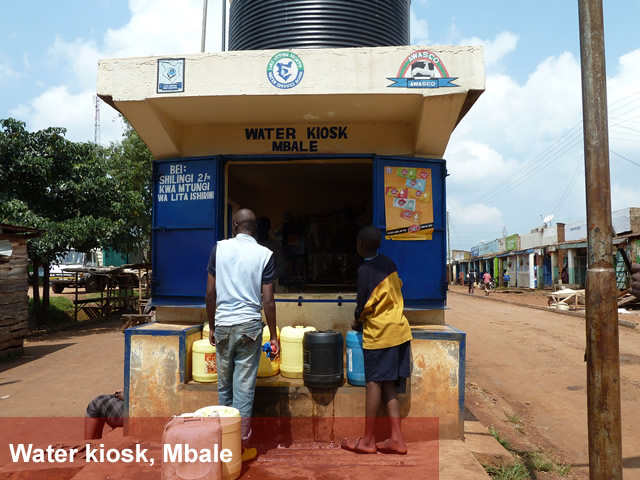 The Urban Investments through its Urban Projects Concept (UPC) was established in 2007 to respond to the specific water and sanitation challenges of urban low-income settlements in Kenya. There are approximately 2,000 low-income areas in the country with an estimated total population of close to eight million. These low-income areas, which are a mixture of unplanned informal settlements and planned low-income residential areas, have inadequate water supply and sanitation.
The portfolio of the urban investments has grown over time and today it comprises of two components:
- Urban Projects Concept (UPC) was developed in 2007 to respond to the water and public sanitation challenges of urban low-income areas
- Upscaling Basic Sanitation for the Urban Poor (UBSUP) was initiated in 2011 to respond to household/ plot level sanitation challenges
The Urban Investments’ objective is to provide technical and financial support for water and sanitation projects in low-income urban areas. In addition, it focuses on:
- Improving public health,
- Contributing to the improvement of urban livelihoods,
- Reducing unaccounted-for water,
- Building capacity at water utility level,
- Ensuring that low-income areas are perceived as a business opportunity.
Target clients of the Urban Investments
The Urban Investment Programme primarily targets the urban poor living in both planned and unplanned low-income areas. The projects are implemented through registered water utilities, the WSPs, throughout the country. Besides implementation, the WSPs are responsible for the management of project funds as well as for the successful and sustainable operation of the project.
How the Urban Investment Programme works
The Urban Investment Programme is enabling the WSPs to extend their formalised services to the unserved and underserved urban poor living in low-income areas by financing projects that incorporate simple, cost-effective and sustainable technologies. The Water Fund provides various forms of support to water utilities, urban communities and other stakeholders including:
- Funding for project proposals that address the urban poor with improved water supply and sanitation services,
- Data on almost all urban low-income areas in the database MajiData, which facilitates the preparation of project proposals by the water utilities,
- Online toolkits that assist the water utilities, the communities involved and other stakeholders to plan, implement and operate water supply and sanitation schemes in low-income areas,
- Technical standards, drawings and bills of quantities,
- Regular workshops for water utilities enabling the members of staff of the providers to share experiences and learn from challenges faced and best practices,
- Visualisation (online) of all implemented projects with a focus on project operation.
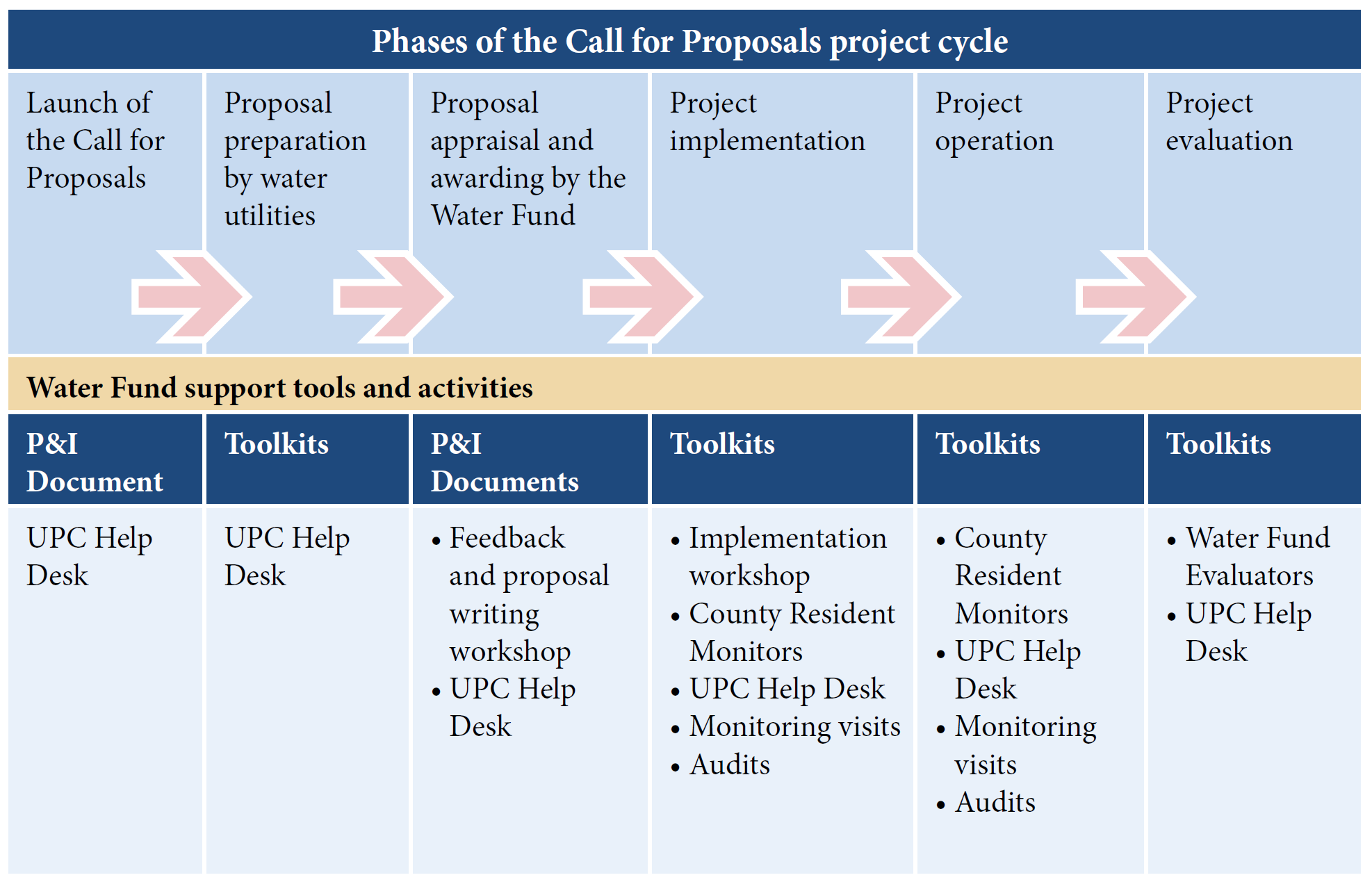
The financing of the projects in the Urban Investments programmes, including both UPC and UBSUP, with funds from different development partners, is done through Calls for Proposals (CfP). With every launch of a Call for Proposals, the urban water utilities are invited to prepare and submit proposals for the improvement of water supply and sanitation in the low-income areas within their service area. WSTF then does the appraisal and the awarding of project proposals. The CfP approach encourages competition and an efficient allocation of funds.
The figure below shows the various support tools, measures and activities WSTF provides during the various phases of a Call for Proposals project cycle.
The current set of technologies being implemented range from water kiosks and yard taps to water meters (pre-paid and post-paid), network extensions and public sanitation facilities. The Urban Programme is continuously working on extending the technical options. UBSUP has developed a set of household/plot level sanitation options and onsite wastewater treatment facilities.
Development partners
Since 2008, the Urban Investment has been financed by the European Union together with the German Development Bank (KfW). The German Gesellschaft für Internationale Zusammenarbeit (GIZ) started its cooperation with WSTF through the Water Sector Reform Programme in 2007. Their main role at WSTF is the provision of technical support for the Urban Investments, including UBSUP.
In July 2011, the Bill & Melinda Gates Foundation (BMGF) partnered with the WSTF, KfW and GIZ to roll out the five-year urban sanitation programme UBSUP that aims to provide sustainable sanitation services to an additional 400,000 people in Kenya’s urban low-income areas. The Investment specifically targets the populations in the “sanitation hotspots” — the informal and formal, unplanned and planned, low-income urban settlements where child mortality is twice the national average.
In 2013, KfW supported the Water Fund to implement Aid on Delivery (AOD) which provides a 50% subsidy for commercial loans to WSPs for water and sanitation projects. The World Bank has partnered with the Water Fund to implement Output-Based Aid (OBA) which provides a 60% subsidy for commercial loans to WSPs who in turn will increase connections to low-income areas.
Achievements of the Urban Investments
For the people living in urban low-income settlements, the Urban Investment interventions have brought better health for children and adults, and improved living standards. A survey carried out to assess the impact of water kiosks showed overwhelming acceptance by the residents, who reported improved access to water, a drop in waterborne diseases, improved household hygiene, improved security when fetching water, and an increase in productive and leisure time thanks to less time spent on water duties.
Since 2007, KES 3.6 billion has been invested by the Urban Investment. The impact of these investments is manifold: Approximately two million urban Kenyans have been reached with improved water supply and public sanitation services.
The outputs of the projects include:
- Construction of 646 water kiosks,
- Construction and rehabilitation of 2,013,865 km of pipeline,
- Construction of public sanitation facilities, water storage tanks, yard taps and installation of pumping units,
- Successfully piloted prepaid yard taps with the Nakuru Water and Sanitation Services Company,
- Subsidy provision for household sanitation and commercial loans.
Additional impact has been achieved such as capacity building of water utilities, the launch of MajiData and the development of new technologies.
The Urban Investment successfully piloted the Up-scaling Basic Sanitation for the Urban Poor (UBSUP) programme in three water utilities. The programme aims to improve sanitation at household and plot level. This has been upscaled countrywide and so far 20 water utilities are implementing the 1st Call for Proposals for UBSUP. Marketing of improved SafiSan toilets has been done and solutions along the entire sanitation value chain have been supported. UBSUP aims to reach up to 400,000 people with adequate sanitation.
Key elements of the Urban Investments’ success
A number of factors contribute to the success of the Urban Investment:
- Transparent procedures and funding criteria
- Competitive allocation of funds through Calls for Proposals (“value for money”)
- Embedment in the sector framework: alignment to sector strategies
- Use of local institutions for implementation (only registered water utilities)
- Comprehensive approach: financing + supervision + capacity building of local implementers
- “Going the last mile” with innovative low-cost water and sanitation solutions
- Measuring impact through tailor-made baseline surveys and information systems, and long-term performance monitoring of utilities
- Capacity building of the water utilities to enable them to implement the projects
- Repetition of standardised project cycles allows for continuous improvement
- Use of the county resident monitors in monitoring of the projects
Challenges and future perspectives
Some of the challenges being faced by the Urban Investments include:
- Inadequate funds to finance all the proposals that meet the criteria for funding,
- Slow implementation of the projects by the water utilities. The water utilities are not able to complete the projects within the given periods,
- Initially slow uptake of the UBSUP projects,
- Audit issues contributed to unquestioned costs that the water utilities can address but that were not given any priority.
Future prospects include the opportunity to work with the counties in supplying water and sanitation in the underserved areas of Kenya. Also, there are innovation opportunities for project implementation, data collection and reporting.
What is Results-Based Financing?
 The Results-Based Financing (RBF) investment programme is a commercial financing facility that became operational in WSTF in December 2014 after the Government of Kenya signed a Grant Subsidiary Agreement with the German Development Bank (KfW) and the World Bank. The grants are provided by the Swedish International Development Agency (SIDA) through the KfW via the Aid on Delivery (AoD) programme for 1.36 million EUR and the World Bank Output-Based Aid (OBA) programme for 11.835 million USD.
In recognition of the need to reduce grant financing for commercially viable water utilities and in order to introduce a new business model to water financing, the RBF programme is supporting water utilities that are investing in water supply and sanitation improvement projects in the low-income and underserved rural and urban areas in Kenya. The WSPs are able to leverage loans from local financing institutions, which are then subsidised at a percentage of the project cost on attainment of agreed deliverables.
Target clients of the Results-Based Financing
The primary beneficiaries of the projects under the RBF programme that have been reached out of the targeted 150,000 (until 2018) as of June 2016 are a total of 3,645 households or 21,650 people. These are broken down as 16,940 people accessing individual water connections, 4,290 people accessing water kiosks, and 420 people accessing yard taps.
How the Results-Based Financing works
The projects to be implemented by the water utilities are pre-financed with commercial loans from domestic lenders in Kenya on market terms. The loans will support investments linked to the following:
- Construction/expansion of water and sewer networks to reach unserved consumers,
- Rehabilitation/improvement of existing networks e.g. the non-revenue water reduction programme,
- Water and/or sewer connections to households and public points,
- Water and sewer treatment facilities.
After completion of their projects, the water utilities are incentivised through applying one-off subsidies provided under the RBF sub-programmes for up to 60% under the OBA and up to 50% under the AoD programmes.
To facilitate the uptake of the RBF subsidies, the water utilities’ projects are prefinanced with commercial loans from local lenders. The RBF programme is currently working with three commercial banks, namely Sidian Bank, Kenya Commercial Bank (KCB) and Housing Finance, which have access to a 50% guarantee provided by USAID. Other banks, including Equity Bank, Family Bank, GT Bank and Coop Bank, have also been approached by the Water Fund and have shown interest in financing the water utilities under the programme.
Achievements of the Result-Based Financing
RBF commercial loans by local banks
As of June 2016, the RBF programme has facilitated the financing of five projects and reaching cumulative loan disbursements of KES 338.18 million since its creation in December 2014. The commercial facilities are loaned out to interested water utilities at the prevailing market rates. Of the total disbursements to date, the Sidian Bank has contributed 76.5%, followed by Housing Finance (23.5%), while KCB is yet to make a disbursement under the RBF programme.
RBF subsidies by WSTF
The RBF programme has so far disbursed subsidies valued at KES 69.48 million to four projects since inception (Table 12). The AoD programme contributed 62% of the total subsidies while 38% came from the OBA programme.
The 11.835 million UBA grant for the OBA facility consists of 9.5 million USD (KES 950 million) and 2.335 million USD (KES 233.5 million) for implementation support activities while the AoD grant facility for 1.36 million EUR (KES 150 million) is available for AoD subsidies.
Partners
As mentioned before, two categories of partners facilitate the work of the RBF programme:
- Local banks that pre-finance projects with commercial loans: Sidian Bank, KCB and Housing Finance (which have access to a 50% guarantee provided by USAID). Other banks including Equity Bank, Family Bank, GT Bank and Coop Bank have shown interest in financing the water utilities under the programme.
- Partnerships for financing subsidies after the projects are implemented: Government of Kenya, KfW, World Bank, SIDA.
Key elements of the Results-Based Financing success
- The programme is contributing to SDG 6 and Kenya‘s Vision 2030 by ensuring the availability and the sustainable management of water and sanitation for all. It is receiving favourable support from the Government of Kenya through the Ministry of Water and Irrigation, the county governments, water services boards and WASREB who are the stakeholders mandated to provide water supply and sanitation services in low-income and underserved areas of Kenya.
- The ownership of the water and sanitation infrastructure by both the water utilities and the county governments is increasing under the programme.
- The beneficiary water utilities are now fully registered companies under the Kenyan Companies Act and have the capacity to service commercial loans, which can be subsidised under the RBF programme.
Challenges and future perspectives
Challenges
- Lack of viable project proposals: To assist WSPs in developing viable project proposals, the WSTF is providing technical assistance (TA) funding under the RBF programme. The WSPs will procure consultancy services for developing project technical designs, project cash-flows, environmental and social management plans and social connection policies, which are prerequisites for eligibility under the RBF subsidy programme.
- Failure to raise connection fees by household beneficiaries: The failure to raise funds for connections by household beneficiaries is being addressed through the inclusion of at least 60% of the total cost of connections in the commercial loan to be borrowed by the WSPs. The households will then contribute at least 40% of the costs. The beneficiaries are expected to repay the 60% of connection costs borrowed by the WSP through monthly instalments included in their tariffs over an agreed period.
- Increased demand for commercial financing facilities: The RBF programme is noting an increasing demand for the introduction and improvement of water and sanitation services in all 47 counties. This is attributed to population growth, dilapidated infrastructure and physical and commercial non-revenue water. This is resulting in increased demand for commercial financing facilities by water utilities while banks are beginning to understand the water sector.
- Lack of coordination between water utilities and county governments: A number of water utilities are failing to meet the eligibility criteria under the RBF programme due to poor relationships with their county governments. It is a strict requirement that projects to be undertaken by the water utilities are approved by and will receive support from the county governments. Some water utilities are not applying for the RBF subsidies due to this irregularity.
- Slow uptake of commercial financing as an option for WSPs: The majority of water service providers in Kenya are not aware of the terms and conditions of the RBF subsidy programme. To increase awareness of the RBF programme, the WSTF have been undertaking workshops, seminars and open days to reach out to all WSPs in Kenya. The WSTF intends to launch a Call for Proposal under the AoD programme in July 2016 to invite WSP applications under the RBF programme.
Targets
The RBF programme pipeline as of June 2016 has a total of 17 projects with an estimated commercial loans requirement of KES 2.304 billion and a potential subsidy demand of KES 1.241 billion (Figure 8). The target beneficiaries for the OBA are 150,000 by June 2018.
Future perspectives
The RBF programme is a short-term programme that is aiming to achieve the following after its implementation phase.
The TA funding are short term facilities where external consultants are working with water utilities staff and building capacity in developing project proposals and in supervising the projects. It is expected in the near future that the water utilities will be able to undertake these tasks internally, thus becoming autonomous and consequently reducing their over-reliance on external assistance.
The RBF subsidies are meant to stimulate initial financing for the water sector by commercial lenders in Kenya. The subsidies are meant to assist the water utilities to repay their loans while at the same time improving revenue collection from the established projects. It is therefore envisaged that the established projects will result in increased revenue inflows enabling future loan borrowing by the water utilities, which will be repaid using company revenues.
The RBF facilitation in linking water utilities to commercial lenders sets in as an opportunity for commercial lenders to better understand the water sector while, at the same time, the water utilities are now considering borrowing from commercial banks as a future sustainability strategy and moving away from overdependence on traditional grants.
The RBF programme is therefore building confidence in the financial sector to consider the water sector as a viable business sector, where commercial financing can be applied and fully utilised for the advancement of the people of Kenya.
> Download the Results-Based Financing booklet here